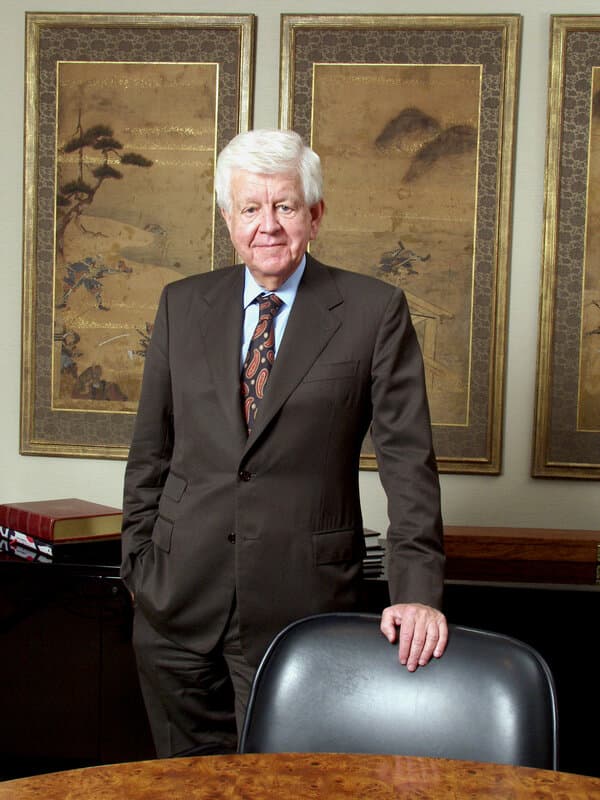
Bruce Crawford, Arts-Loving Adman Who Led the Met Opera, Dies at 96
Bruce Crawford, a visionary advertising executive and steadfast champion of the arts who dedicated decades of service to the Metropolitan Opera, passed away on January 7, 2026, at the age of 96 in his Manhattan home. His death marks the end of an era for the cultural landscape of New York City, where his influence extended far beyond the boardrooms of Madison Avenue into the gilded halls of Lincoln Center. Born in 1929 in a modest suburb of Chicago, Crawford’s early life gave little indication of the towering presence he would become in the worlds of commerce and culture. The son of a newspaperman and a schoolteacher, he developed an insatiable curiosity and a love for storytelling that would define his career. After serving a brief stint in the Army during the waning days of the Korean War, Crawford utilized the G.I. Bill to attend Yale University, where he studied literature and art history. It was there that he honed his distinctive voice—blending the analytical rigor of a marketer with the soul of a patron. Upon graduating in 1952, Crawford moved to New York City, the undisputed capital of both advertising and the performing arts. He started his career at a small agency, quickly rising through the ranks due to his uncanny ability to understand consumer psychology. In 1960, he co-founded the agency Crawford & Morris, a firm that would eventually become a powerhouse in the industry. The agency was known for its witty, sophisticated campaigns that avoided the hard-sell tactics common at the time. Crawford believed that a good advertisement should tell a story, not just shout a price. He oversaw campaigns for major airlines, luxury automobiles, and financial institutions, often traveling the globe to capture the perfect image or phrase. Despite the demands of a high-profile career, Crawford never lost his passion for the opera. He had been introduced to the art form as a teenager by his grandmother, who saved for months to buy tickets to a performance of Puccini’s "La Bohème." He later recalled the experience as "transformative," noting how the combination of soaring music and high drama captured the full range of human emotion. As his financial success grew, so did his commitment to the arts. He served on the boards of various cultural institutions, but it was the Metropolitan Opera where he would make his most enduring mark. Crawford joined the Met’s Board of Directors in 1978, a time when the institution was facing significant financial headwinds and a changing audience demographic. He brought a corporate discipline to the non-profit world, advocating for aggressive fundraising strategies and modernized marketing. However, he was also a fierce defender of artistic integrity. When arguments arose about dumbing down repertoire to attract younger crowds, Crawford stood firmly with the music directors, arguing that the Met’s strength lay in its commitment to excellence. He served as Chairman of the Board from 1992 to 2002, a critical decade that saw the Met navigate the transition from traditional radio broadcasts to the era of high-definition cinema simulcasts. Crawford was instrumental in the launch of the Met’s Live in HD series, which brought performances to movie theaters around the world. He famously argued that the Met had a duty not just to preserve the past, but to "invade the future." Under his leadership, the Met’s endowment grew significantly, ensuring the survival of complex productions that might otherwise have been deemed too risky financially. Colleagues remembered Crawford not just for his business acumen, but for his warmth and wit. "Bruce had this rare gift," said a former Met General Manager. "He could look at a balance sheet and see the humanity behind the numbers. He understood that funding a production of Wagner’s 'Ring Cycle' wasn't just an expense; it was an investment in the human spirit." He was known for hosting lavish dinners at his Upper East Side apartment, where titans of industry sat beside struggling young singers, bound together by their love for the art form. His tenure was not without controversy. In the late 1990s, a dispute arose regarding the Met’s use of surtitles—projected translations above the stage. Purists argued it ruined the visual aesthetic; modernizers argued it was essential for accessibility. Crawford, ever the pragmatist, eventually swung his weight behind the surtitles, famously quipping, "I’d rather they read the words and understand the plot than stare at the ceiling wondering why the tenor is screaming." After stepping down as Chairman, Crawford remained active as Chairman Emeritus. He continued to attend nearly every opening night, often seen in the white tie and tails that he considered the proper uniform for the occasion. He also devoted time to philanthropy, establishing the Crawford Fund for Young Artists, which has provided scholarships to hundreds of aspiring opera singers and conductors. In his later years, Crawford turned his attention to writing. He published a memoir, "The Pitch and the Aria," in 2010, which detailed his dual life in advertising and opera. The book was praised for its insights into the parallels between selling a product and selling a performance—both required a deep understanding of narrative and emotion. Bruce Crawford is survived by his daughter, Eleanor, a painter based in Paris, and two grandchildren. His wife, Margaret, predeceased him in 2015. While the advertising world has lost a pioneer and the opera world a guardian, his legacy lives on in the very breath of the Met—every note sung on its stage carries a faint echo of his unwavering belief in the power of beauty.