Emma Stebbins: Convention-Defying in Life, Traditional in Art
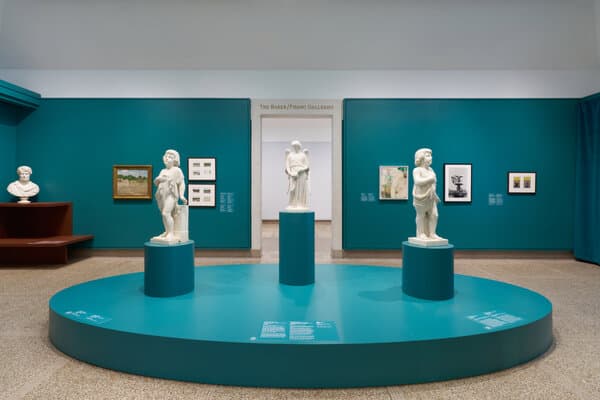
The enduring legacy of Emma Stebbins, a pivotal figure in 19th-century American sculpture, is often overshadowed by her personal life. Stebbins, born in 1815 in New York, defied the rigid social conventions of her era, particularly regarding gender and sexuality. Her most significant relationship was with the renowned actress Charlotte Cushman, a bond that lasted for nearly two decades and was openly acknowledged within their progressive social circle. This partnership provided Stebbins with the emotional and financial support necessary to pursue her artistic ambitions in Rome, where she established herself among the thriving community of American expatriate artists. Despite her radical lifestyle, Stebbins’s artistic output adhered strictly to the Neoclassical tradition. Her sculptures are characterized by idealized forms, smooth marble surfaces, and a serene, detached beauty that aligned with the prevailing tastes of the academic establishment. This contrast between her unconventional biography and her conventional artistry presents a fascinating study of the boundaries between personal rebellion and professional assimilation in the 19th century. Among her most celebrated works is the bronze statue of Horace Mann, located at the Massachusetts State House. Unveiled in 1856, this monument captures the intellectual gravitas of the education reformer. While the composition is traditional—Mann stands in a contemplative pose, draped in classical robes—it executed with a technical proficiency that garnered significant acclaim. The sculpture stands as a testament to Stebbins’s ability to navigate the male-dominated art world, securing prestigious public commissions that were rarely awarded to women at the time. Another key work, 'The Angel of the Resurrection,' created for the Mount Auburn Cemetery in Cambridge, further exemplifies her mastery of the Neoclassical idiom. The figure is ethereal and graceful, embodying a spiritual transcendence that resonated with the Victorian sensibilities of the afterlife. Critics of the time praised the work for its 'purity of line' and 'lofty sentiment,' qualities that were essential for public acceptance. However, the most intimate and revealing aspect of Stebbins’s oeuvre is the portrait medallion she created of Charlotte Cushman. Unlike her public monuments, this piece exudes a palpable affection and psychological depth. It captures Cushman’s distinct features with a sensitivity that transcends the typical formal rigidity of the medium. This artifact serves as a crucial link between Stebbins the woman and Stebbins the artist, suggesting that while her style remained orthodox, her muse was profoundly personal. The art historical narrative often struggles to categorize Stebbins. Because she did not explicitly challenge the aesthetic norms of her time through her work, she is frequently overlooked in discussions of feminist art history, which tend to prioritize radical stylistic innovation. Yet, Stebbins’s significance lies perhaps more in her existence than her innovation. By thriving in a conservative medium while living an unorthodox life, she destabilized the presumed connection between an artist’s private conduct and their public output. Her career peaked during the height of the American Renaissance, a period of intense cultural nationalism. Sculptors like Stebbins were tasked with creating monuments that would define the young nation’s identity. In this context, her adherence to classical models was not merely a stylistic choice but a strategic alignment with the cultural aspirations of the time. To secure commissions for institutions like the Brooklyn Institute of Arts and Sciences, an artist had to demonstrate a mastery of the 'high art' traditions imported from Europe. Consequently, the 'convention-defying' label applies almost exclusively to Stebbins’s biography. Her letters reveal a woman of keen intellect and determination, navigating the complex social dynamics of Rome’s artistic colonies. She lived openly with Cushman, hosting gatherings that included other artists and intellectuals who existed on the fringes of polite society. This 'Boston marriage' was a radical assertion of autonomy. The tension between her life and work invites a re-evaluation of how we define artistic radicalism. Is an artist radical only when their work visually disrupts the status quo, or can a life lived authentically in defiance of societal norms constitute a form of artistic statement? Stebbins suggests the latter. She operated within the cracks of the system, utilizing the system’s own tools—bronze and marble—to carve out a space for herself. In her later years, Stebbins continued to produce portraits and busts, though the market for Neoclassical sculpture began to wane with the approach of Modernism. She remained in New York, outliving Cushman by several years. The decline in her artistic visibility after her death reflects the shifting tides of taste, where the serene idealism of Neoclassicism fell out of favor against the raw energy of the new century. Yet, looking back at the patinated bronze of Horace Mann or the alabaster curves of 'The Angel of the Resurrection,' one sees not just a reflection of Victorian values, but the quiet defiance of a woman who refused to be confined. Emma Stebbins remains a paradox: an artist who painted within the lines, but lived entirely outside of them. Her legacy challenges us to look beyond the surface of the marble and see the revolutionary pulse of the life that shaped it.