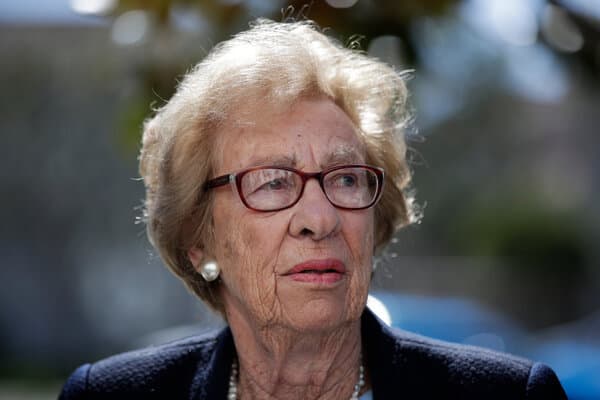
Eva Schloss, Anne Frank’s Stepsister and Holocaust Survivor, Dies at 96
Eva Schloss, a Holocaust survivor and the stepsister of Anne Frank, passed away at the age of 96. Her death marks the end of an era, as she was one of the last living individuals with a direct connection to the young diarist whose writings became a seminal testament to the horrors of the Nazi regime. Born in Vienna in 1929, Eva was the daughter of Erich Geiringer, a successful businessman. In 1937, her family fled the expanding Third Reich and settled in Amsterdam, where they formed a close friendship with another German-Jewish refugee family: Otto Frank, his wife Edith, and their two daughters, Margot and Anne. The two families shared a happy existence in the Dutch capital until the Nazi invasion of the Netherlands in 1940. Life became increasingly difficult for Jews under German occupation. In 1942, facing deportation, Otto Frank went into hiding in a secret annex above his office at Prinsengracht 263. On the same day the Franks disappeared into hiding, the Geiringers were also preparing to go into hiding, but they were betrayed and arrested during a police raid on their safe house. Eva, her mother, and her brother were sent to Westerbork transit camp, and eventually transported to Auschwitz-Birkenau death camp in Poland. Eva survived the horrific death march from Auschwitz as the Soviet Army approached in January 1945. She and her mother eventually returned to Amsterdam, where they learned that her father and brother had perished. It was there that she reconnected with Otto Frank, who had been the sole survivor of his family. He had returned from Auschwitz to find his wife Edith had died at Auschwitz, and his daughters Margot and Anne had died of typhus at Bergen-Belsen just weeks before liberation. Eva and Otto grew close. They married in 1953 and relocated to Basel, Switzerland, where they raised a family. Eva dedicated her life to preserving the memory of the victims, particularly that of her step-sister Anne. She spent decades sharing her story of survival, offering a unique perspective on the girl who wrote 'The Diary of a Young Girl.' While Anne Frank’s diary captured the private thoughts of a teenager in hiding, Eva’s narrative provided the world with the account of what happened immediately before and after the eight refugees in the Secret Annex went into hiding. She often spoke of the few months she spent as a family member with Anne and Margot, offering insights into their characters. In her later years, Eva became the honorary president of the Anne Frank Foundation. She was instrumental in the preservation of the Anne Frank House in Amsterdam. She also authored several books, including 'Anne Frank Remembered,' which provided a personal memoir of her life and her connection to the famous diarist. Her death comes at a time when the number of Holocaust survivors is rapidly dwindling. For decades, Eva served as a living bridge between the past and the future, ensuring that the atrocities committed by the Nazis would not be forgotten. She often expressed concern about the rise of anti-Semitism in the modern world, urging new generations to remain vigilant against hatred and intolerance. Tributes have poured in from around the world. Jewish leaders, politicians, and educators have praised her courage and her unwavering commitment to education. They note that her voice was essential in humanizing the statistics of the Holocaust, turning the tragedy of millions into a personal story of resilience and love. Eva Schloss is survived by her children and grandchildren. Her legacy, intertwined with that of Anne Frank, will continue to educate and inspire millions. As the last living person to share a household with Anne Frank, her passing signifies a profound shift in how the history of the Holocaust will be told—transitioning from personal memory to historical record. The duty of remembrance now falls to the generations that follow, guided by the words and deeds of survivors like Eva Schloss.