The Many Faces of Trump: What We Saw When We Interviewed the President
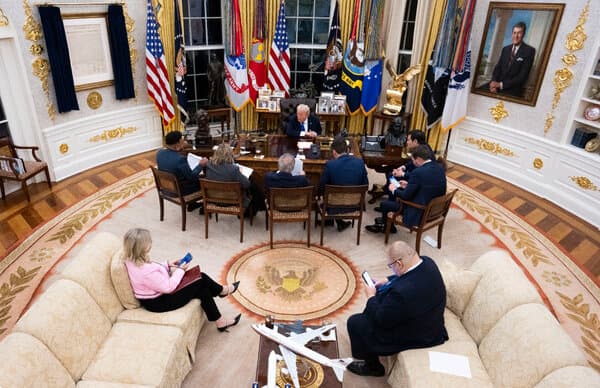
The Oval Office, often perceived as the epicenter of American power, took on a distinctively personal atmosphere during our recent visit with President Donald Trump. Located within the West Wing of the White House, the room serves not merely as a workplace but as a stage where the administration's narrative is crafted and projected to the world. Upon entering, one is immediately struck by the gilded grandeur and historical weight of the space, filled with portraits of past presidents and artifacts of state. However, the focus quickly narrows to the man occupying the Resolute Desk, a figure who dominates the physical and psychological landscape of the room. Trump’s presence is formidable and unrelenting. He engages with an intensity that can be described as restless energy, constantly moving, gesturing, and commanding attention. The interaction is less a structured Q&A and more a stream of consciousness, a torrent of assertions, grievances, and boasts that flow with a rhythmic cadence. He oscillates between topics with a jarring agility—from the intricacies of trade deficits to the seating arrangements at a recent gala, from the virtues of his golf courses to the perceived failings of his predecessors. This discursive style seems designed to overwhelm, to keep the interviewer off balance, and to ensure that he remains the undisputed narrator of events. Visually, the President presents a carefully curated image. The signature long tie, the polished leather shoes, and the meticulously coiffed hair are elements of a brand that has become synonymous with his public persona. Yet, beneath the veneer of invincibility, there are glimpses of the toll of the office. The posture may remain defiant, but the lines on his face speak to the relentless scrutiny and the weight of constant battle. His eyes, sharp and searching, scan the room, rarely settling on a single object for long, always assessing, always judging. Communication with Trump requires a specific set of tactics. Flattery often serves as a lubricant for conversation; acknowledging his achievements invariably opens the door to further discussion. However, he is easily triggered by perceived slights or challenges to his narrative. When questioned on uncomfortable topics, the atmosphere shifts palpably. The jovial demeanor can instantly harden into defensiveness or outright hostility. He retreats into familiar talking points, launching into broadsides against the media, political opponents, or foreign nations who have crossed him. The word "wrong" becomes a refrain, a shield against any fact that contradicts his worldview. One of the most striking aspects of the interview was the juxtaposition of the mundane and the monumental. A conversation about the gravity of nuclear proliferation could be interrupted by a sudden tangent regarding the ratings of a cable news program. The President views the world through a hyper-transactional lens, where loyalty is the highest currency and slights must be avenged. He possesses a transactional memory, remembering exactly who praised him and who criticized him, often years after the fact. The physical environment reflects his tastes. The room has been updated to suit his preferences, with heavier curtains and a more ornate aesthetic compared to his predecessor. He positions himself as an outsider who has conquered the establishment, a billionaire businessman who claims to speak for the forgotten men and women of America. This populism is a core component of his appeal, resonating with a base that feels alienated by traditional political elites. During the interview, he frequently invoked this connection, referencing rally sizes and voter enthusiasm as metrics of his success. It becomes clear that for Trump, the presidency is an extension of his personal brand. There is little distinction between Donald Trump the private citizen and Donald Trump the Commander-in-Chief. The impulses are the same: the desire for validation, the instinct to fight back against perceived enemies, and the relentless drive to "win." He views the presidency as a conquest, a prize he rightfully earned, and he governs with the brash confidence of a corporate CEO rather than the measured caution of a statesman. As the interview draws to a close, the energy does not dissipate. He remains wired, ready to move on to the next engagement, the next camera, the next audience. Leaving the Oval Office, one is left with the impression of a man who is both incredibly powerful and strangely isolated, trapped in a bubble of his own making, fueled by praise and besieged by criticism. The many faces of Trump—the charmer, the fighter, the victim, the victor—are all facets of a singular, complex persona that continues to defy conventional political analysis. The room, silent once again, holds the echoes of a conversation that felt like a performance, a debate, and a confession all at once, leaving the observer to wonder where the man ends and the myth begins.