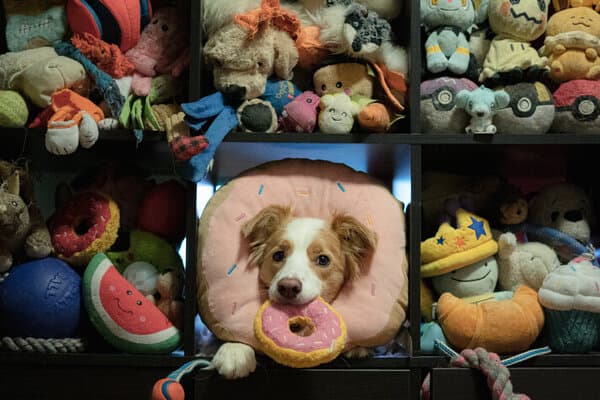
Canines Master Vocabulary Through Specialized Toy Training
A growing body of research is shedding light on the remarkable cognitive abilities of man's best friend, specifically regarding how some dogs learn to understand human language. Unlike the average canine that responds to a handful of commands like 'sit' or 'stay,' a select group of gifted dogs is demonstrating an ability to learn the names of toys and objects at a pace that rivals human toddlers. These canines aren't just associating a sound with a specific action; they are grasping the concept of symbolic reference, where a word represents a unique item. This phenomenon was recently explored in depth, focusing on the methods and results of training dogs to expand their active vocabularies. The study highlights that certain breeds—and even specific individuals within breeds—possess a cognitive edge that allows them to categorize objects by name. The research, spearheaded by experts in animal cognition, utilized a unique methodology centered on "fast mapping." This is the process by which children rapidly learn new words by hearing them used in context. In the experiment, dogs were presented with a known toy and a novel toy. When the owner asked the dog to retrieve the novel toy by name, the dog had to infer which one was the unknown object. The results were striking: many dogs in the study were able to correctly identify the new toy after only a few exposures to the word. This suggests that dogs have a much higher capacity for linguistic understanding than previously believed. The study involved a rigorous testing protocol where owners would ask the dog to fetch a specific toy from a group of items. The dogs that excelled were those that demonstrated high levels of focus and enthusiasm for the game. However, the ability to learn these words is not universal among all dogs. The research identified a stark contrast between the so-called "Gifted Word Learners" (GWLs) and the average dog. While the average dog required dozens or even hundreds of repetitions to link a word with an object, the GWLs could make the connection in just a few tries. This disparity suggests that there may be a genetic or neurological component to this ability. Researchers scanned the backgrounds of the successful dogs and found that many of them were breeds traditionally used for herding or retrieving, jobs that require close attention to human commands. Yet, even within these breeds, the ability was rare, indicating that individual personality and cognitive style play a major role. The implications of this research extend beyond the novelty of teaching dogs tricks. It challenges the long-held assumption that human language is uniquely complex and that animals lack the neural architecture to process it. By understanding how dogs learn words, scientists gain insight into the evolution of language itself. If a species separated from humans by millions of years of evolution can grasp symbolic reference, it implies that the building blocks of language are perhaps more fundamental to intelligence than we thought. Furthermore, the study notes that the dogs who learned these words showed signs of satisfaction and engagement, suggesting that the mental challenge is stimulating and enjoyable for them. To conduct these experiments, researchers had to rely on owners who were willing to dedicate significant time to training. The owners were instructed to use a specific tone of voice and consistent naming conventions to avoid confusing the dogs. The data collection involved video recording the sessions to ensure the dogs were not picking up on subtle visual cues or gestures from the owners—a phenomenon known as the Clever Hans effect. The rigorous controls used in the study ensured that the dogs were truly responding to the auditory cue of the word. In many cases, the owners were blind to which toy was the "correct" one during testing phases, ensuring the results were purely based on the dog's understanding. One of the most fascinating aspects of the research was the discovery that these dogs could categorize objects. Not only could they learn the names of individual toys, but they also seemed to understand that names refer to specific items, not just a general category of play. For example, if a dog knew the name "ball," it knew that a specific red ball was "ball," but a different blue ball was not necessarily the same word unless taught. This distinction is crucial because it shows that the dog is learning the specific label, not just a general association. This level of discrimination is highly sophisticated and mirrors the way human children learn nouns. The study also addressed the question of retention. How long do these canine vocabularies last? The researchers followed up with the owners and the dogs months after the initial training. They found that the dogs retained the vocabulary surprisingly well, even without continued practice. This indicates that the learning was not just a temporary trick but a genuine cognitive encoding of the information. The dogs could recall the names of objects they hadn't seen in weeks, pointing to a robust memory capacity for language. This retention is likely linked to the emotional connection the dogs have with their owners; the act of learning the names was a collaborative game that strengthened their bond. Furthermore, the research delves into the neurological basis of this ability. While the study didn't involve invasive brain scans, it drew on existing literature regarding canine brain structure. Dogs have a region in their temporal lobe that is analogous to the human Wernicke's area, which is responsible for language comprehension. In the gifted dogs, it is hypothesized that this region may be more developed or efficient. However, the study emphasizes that environment and training are just as critical as biology. A dog may have the potential for a large vocabulary, but if it is never exposed to consistent training, that potential remains untapped. The methods used by the researchers to identify these gifted dogs were unique. They launched a citizen science project, appealing to dog owners worldwide to test their pets. Owners who suspected their dogs were particularly smart were invited to participate in a preliminary test at home. This approach allowed the researchers to gather data from a massive pool of subjects, far larger than could be tested in a lab. The owners who made it to the final round were flown to the University of Veterinary Medicine in Vienna for rigorous in-person testing. It was here that the "super dogs" were separated from the pack. During the Vienna tests, the dogs were presented with a battery of challenges. They were asked to fetch toys by name from a room full of distractions. The speed and accuracy with which they performed were recorded. The dogs that passed these tests were then subjected to MRI scans to observe their brain activity while they listened to words. The scans revealed that in gifted dogs, hearing the name of a known object activated specific regions of the brain associated with visual processing. This suggests that when the dog hears the word "ball," it essentially "sees" the ball in its mind's eye. In average dogs, hearing a word didn't trigger this same visual imagery. This research has practical applications as well. Understanding how dogs learn can improve the way we train service dogs, search and rescue dogs, and therapy dogs. If we can teach dogs to understand a wider range of vocabulary, they can perform more complex tasks and assist humans in more nuanced ways. For example, a search and rescue dog that understands the difference between "victim" and "scent" or "medication" and "water" could be far more effective in disaster scenarios. The potential to enhance the working relationship between humans and dogs through better communication is immense. Moreover, the study serves as a reminder of the importance of mental stimulation for pets. Many dogs suffer from boredom and anxiety, which can lead to behavioral problems. Teaching a dog a vocabulary of toys or objects provides a constructive outlet for their mental energy. The researchers noted that the dogs in the study were often calmer and more focused after their training sessions. It turns out that a tired dog is not just a dog that has exercised physically; a dog that has exercised its brain is also a happy dog. The debate about animal consciousness and intelligence is ongoing, but evidence like this pushes the boundaries of what we consider possible. It forces us to look at our dogs not just as pets, but as complex beings with inner lives and cognitive abilities that we are only just beginning to understand. The discovery that dogs can learn the names of objects opens the door to further research into how they understand sentences, grammar, and abstract concepts. While we are a long way from having philosophical conversations with our pets, the gap between human and canine intelligence is narrowing. In conclusion, the ability of certain dogs to build up large vocabularies is a testament to their intelligence and the strength of the human-animal bond. It is a result of a combination of innate potential and dedicated training. The research proves that dogs are capable of much more than we typically give them credit for. By using the method of fast mapping and providing consistent, positive reinforcement, owners can unlock a surprising level of linguistic ability in their canine companions. As we continue to study these "gifted" learners, we may find that the secrets to understanding the evolution of language—and the minds of animals—lie right at our feet, waiting for us to throw the next toy and call it by name.