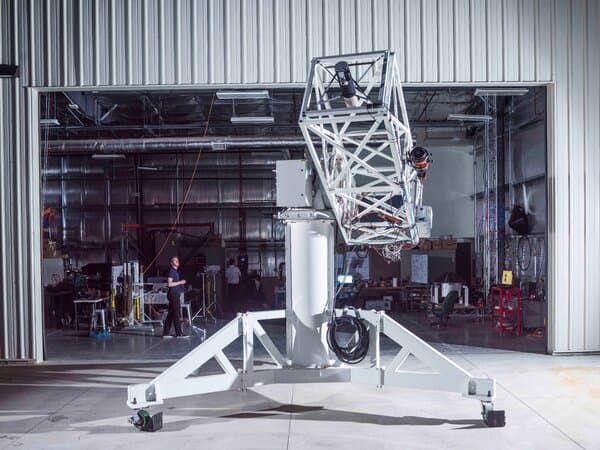
Google's Ex-CEO Eric Schmidt Backs Start-Up Approach to Big Telescopes for Space and Astronomy
Eric Schmidt, the former CEO of Google, has thrown his weight and wealth behind a new venture to revolutionize how we look at the stars. Schmidt, alongside his wife, Wendy Schmidt, is funding the construction of two cutting-edge observatories in Chile’s Atacama Desert. This initiative, known as the Schmidt Telescope Observatory, represents a significant shift in the world of astronomy: moving away from the traditional, massive, and prohibitively expensive observatories toward a more agile, start-up style approach using smaller, networked telescopes. For decades, the pinnacle of astronomical discovery was dominated by what the industry calls "monoliths." These are the giant, single-dish telescopes, like the Extremely Large Telescope (ELT) being built by the European Southern Observatory (ESO), which cost billions of dollars and take decades to construct. While powerful, their size and cost limit who can use them and how often. Schmidt believes this model is outdated. He argues that the future lies in distributed systems—multiple smaller telescopes that work in concert to achieve the same or even better results at a fraction of the cost and time. The project in the Atacama is the physical manifestation of this philosophy. Instead of building one colossal instrument, Schmidt’s team is erecting two observatories designed to house arrays of smaller telescopes. These instruments will be specifically tailored to survey the southern sky, a region rich in astronomical targets that have yet to be fully cataloged. The location was chosen for its optimal conditions: the Atacama is one of the driest places on Earth, offering exceptionally clear skies and minimal light pollution, which are critical for deep-space observation. The technological edge comes from the integration of advanced optics and digital imaging, areas where Schmidt’s background in Silicon Valley is evident. The start-up approach emphasizes speed and adaptability. Traditional observatories are rigid; their primary mirrors are cast and ground over years, and their locations are fixed. By contrast, the Schmidt Telescope Observatory is designed to be modular. If camera technology improves, the sensors can be swapped out without rebuilding the entire facility. If computing power leaps forward, the data processing pipelines can be upgraded instantly. This "plug-and-play" capability allows the observatory to stay on the cutting edge without the massive capital expenditure of a monolith. Furthermore, Schmidt’s vision addresses the accessibility problem in astronomy. High-level time on the world’s best telescopes is fiercely competitive. A handful of elite astronomers get the lion's share of observation time, while many others wait years for a chance to gather data. By creating a fleet of efficient, lower-cost telescopes, the Schmidt Telescope Observatory aims to democratize access. The data collected will be made available to a wider pool of researchers, potentially accelerating the pace of discovery. It mirrors the evolution of computing: from mainframes accessible only to the military and large corporations to personal computers available to everyone. Schmidt has long been an investor in astronomical hardware, having previously funded the development of the Giant Magellan Telescope (GMT), another massive project currently under construction in the Atacama. However, his pivot to a distributed model suggests a growing impatience with the slow pace of traditional scientific construction. He has privately voiced concerns that while monoliths are scientifically impressive, they risk becoming obsolete before they are even finished due to the rapid acceleration of technology in other sectors. The observatories currently under construction are just the first phase. The long-term goal is to expand the network, adding more units to increase resolution and survey speed. This could lead to breakthroughs in understanding dark matter, mapping the distribution of galaxies, and finding potentially habitable exoplanets. The sheer volume of data that a networked system can generate—terabytes every night—requires a heavy reliance on machine learning and AI to process, further bridging the gap between the astronomical community and the tech industry. Critics of the start-up approach argue that nothing can replace the sheer light-gathering power of a 30-meter mirror when it comes to peering into the deep universe. They maintain that to see the faintest, oldest light in the cosmos, size does indeed matter. However, Schmidt’s camp counters that targeted surveys and wide-field imaging—the specialties of the Schmidt Observatory—are where the next generation of high-impact discoveries, such as transient events like supernovae or asteroid movements, will likely originate. The construction phase in Chile is currently on schedule, with the first light expected within the next two years. Local officials in the Antofagasta region have welcomed the investment, hoping it will bring jobs and further cement the area's reputation as the world’s premier astronomical destination. As the project progresses, it serves as a real-world test case for a new paradigm in space exploration. If successful, the legacy of Eric Schmidt will not just be in the phones we carry in our pockets, but in how we view the infinite expanse above us. The era of the astronomical start-up has begun, and the old giants of the industry are watching closely.