Scientists Discover 'Cloud-9': The Starless Galaxy That Wasn't
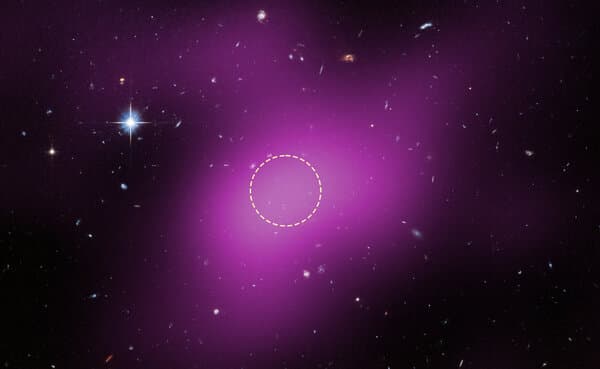
In a finding that challenges fundamental assumptions about how galaxies form, an international team of astronomers has identified a mysterious cosmic structure located approximately 4 billion light-years away. Dubbed 'Cloud-9,' this object appears to be an invisible galaxy—detected solely through its radio emissions—yet it contains no stars, no black holes, and seemingly no dark matter to hold it together. The discovery, published Wednesday in the journal Nature, stems from observations made by the Karl G. Jansky Very Large Array (VLA) in New Mexico. While scanning the distant universe for hydrogen gas, researchers stumbled upon a massive, swirling cloud of neutral hydrogen gas. The cloud spans roughly 100,000 light-years across, making it comparable in size to our own Milky Way. However, despite its substantial mass, it lacks the defining characteristic of every known galaxy: stars. 'This object defies our current taxonomy of cosmic structures,' said Dr. Elena Vasquez, lead author of the study and an astrophysicist at the Max Planck Institute for Radio Astronomy. 'We are looking at a galaxy-sized object that has all the raw materials for star formation—enormous reserves of gas—but for some reason, the process never started.' To confirm their findings, the team followed up with the Hubble Space Telescope. The optical data revealed nothing. No spiral arms, no bright galactic core, no stellar light of any kind. It was a ghost in the machine of the cosmos. The existence of such an object creates a significant puzzle for cosmologists. The prevailing theory of galaxy evolution suggests that all galaxies originate from the collapse of massive gas clouds, which eventually ignite to form stars. Over billions of years, these stars congregate into the spiral and elliptical shapes we recognize today. Cloud-9 represents a potential 'failed galaxy'—one that stalled at the earliest stage of development. However, the mystery deepened when researchers attempted to calculate the object's mass. According to the laws of physics, a gas cloud this large should require a massive amount of invisible dark matter to maintain its rotational velocity. Dark matter acts as the invisible scaffolding that keeps galaxies from flying apart. Yet, when the team measured the movement of the hydrogen gas in Cloud-9, the math didn't add up. There was very little evidence of a dark matter halo. 'This suggests we might be witnessing a different type of physical mechanism entirely,' explained co-author Dr. James Miller from the University of California, Berkeley. 'It looks more like a transient structure, perhaps gas stripped from a larger galaxy during a collision, or maybe a primordial cloud that hasn't yet been compressed by gravity.' The lack of dark matter is particularly shocking. In standard galaxy formation models, dark matter collapses first, creating a gravitational well that pulls in gas and eventually forms stars. If Cloud-9 exists without this dark matter backbone, it could imply that some galaxies can form through 'top-down' scenarios where visible matter dominates, or that we have missed an entire class of dark-matter-deficient objects. The team plans to use the upcoming James Webb Space Telescope to peer deeper into the infrared spectrum to see if there are any faint, low-mass stars or brown dwarfs hiding within the cloud. If none are found, Cloud-9 will cement its status as a true outlier. This discovery opens up new avenues for understanding the 'missing satellite problem' in cosmology—the discrepancy between the number of predicted dark matter halos and the actual number of observed dwarf galaxies. Cloud-9 could represent the tip of an iceberg of thousands of similar gas-rich, starless objects that populate the universe but remain invisible to optical telescopes. For now, Cloud-9 serves as a humbling reminder of how much we still have to learn about the universe. It sits in the void, a massive, swirling cloud of potential that never realized its destiny, challenging our definitions of what it means to be a galaxy.